
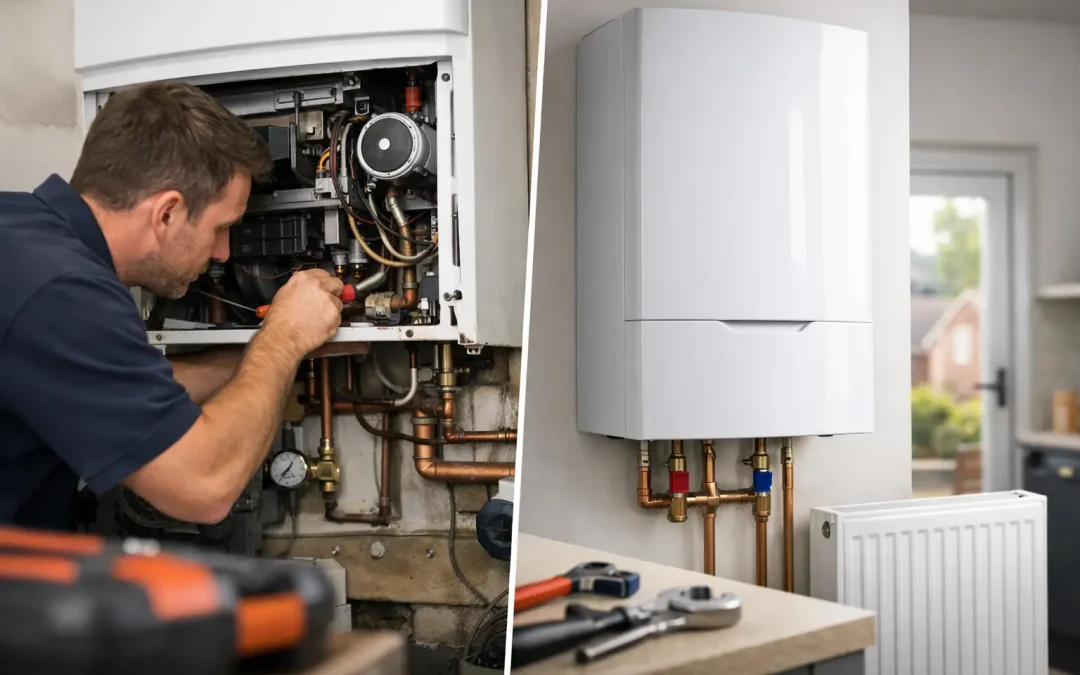
A boiler rarely fails at a convenient time. It starts with pressure dropping, radiators not heating properly, odd noises, or hot water turning unreliable. When that happens, the usual question is boiler repair or replacement, and the right answer depends on more than just whether the boiler can be made to run again.
For homeowners, landlords and letting agents, the real issue is reliability. A repair that gets the heating back on is useful, but only if it is sensible for the age and condition of the system. In some cases, replacing the boiler is the more practical option because it avoids repeat breakdowns, tenant complaints, and more spending over the next few months.
Boiler repair or replacement – what actually matters?
The first thing to look at is not the fault itself, but the wider picture. A failed fan, pump, valve or ignition component can often be repaired. If the boiler has otherwise been working well, has a reasonable service history, and replacement parts are available, repair is often the right route.
That changes when the boiler is older, has had several faults in a short period, or is showing signs of more general wear. Corrosion, leaking components, poor efficiency, recurring pressure loss and unreliable hot water usually point to a bigger issue than one failed part. You may still be able to repair it, but that does not always mean you should.
A good decision comes from balancing three things – current repair cost, likely future reliability, and the disruption caused if it fails again. For a landlord or property manager, disruption often matters just as much as the invoice. A boiler that breaks down twice in winter creates more admin, more tenant frustration, and more risk of further property issues.
When a boiler repair makes sense
Repair is usually the sensible choice when the boiler is not especially old and the fault is isolated. Many boilers in the first part of their lifespan can be repaired economically, especially if they have been serviced properly and the rest of the heating system is in fair condition.
If the problem is clearly identifiable and the boiler has not become unreliable overall, repairing it can give you several more years of service. This is often the case with components that wear out through normal use rather than because the whole appliance is nearing the end of its life.
Repair can also make sense where replacement is not practical immediately. A landlord may need access arrangements, tenant communication and a clear quotation before larger works go ahead. A homeowner may prefer to restore heating and hot water quickly, then plan a replacement at a better time. In that situation, a repair can be a practical short-term step, provided everyone is clear that it may not be the long-term answer.
What matters is honesty about the boiler’s overall condition. A proper assessment should not just focus on getting it firing again. It should also consider whether that repair is likely to hold up or whether you are spending money on borrowed time.
When replacement is the better option
Replacement becomes the stronger option when the boiler is old, inefficient, increasingly unreliable, or uneconomical to keep repairing. There is no single age at which every boiler should be changed, but once a unit reaches the later part of its life, the balance often shifts.
One major factor is repeat breakdowns. If you have already paid for one or two repairs recently and another fault appears, the pattern matters. Even if each individual repair looks manageable, the total cost and inconvenience quickly build up. For landlords, that can mean repeated tenant contact, access issues, and avoidable downtime. For homeowners, it means uncertainty every time the weather turns cold.
Parts availability is another issue. Some older boilers become difficult to support because components are obsolete or hard to source. In those cases, even a relatively small fault can turn into a drawn-out problem.
Efficiency matters too, though it should not be the only reason for replacement. An older boiler may still run, but if it is wasting fuel and struggling to heat the property properly, replacement can improve performance as well as reliability. The benefit is often most noticeable in homes or rental properties where the heating has been inconsistent for some time.
The hidden cost of keeping an ageing boiler going
People naturally compare the cost of a repair with the cost of a new boiler. That is reasonable, but the decision is rarely as simple as one bill versus another.
An ageing boiler often creates small, repeated costs around the main fault. There may be call-outs for low pressure, radiator imbalance, unreliable hot water, thermostat issues, or leaks from stressed components nearby. The boiler may not fail completely every time, but it steadily becomes harder to depend on.
For landlords and agents, there is also the management cost. Every breakdown means calls, emails, arranging access, chasing updates, and reassuring tenants. If the property is vacant, there is also the risk of delay before a new let or concern about the heating system during cold periods.
This is why a cheaper repair is not always the cheaper decision overall. Sometimes replacement reduces both future cost and future hassle.
Boiler repair or replacement for landlords and letting agents
For rental property, the priority is usually dependable heating, clear communication and minimal disruption. That means the best decision is often the one that reduces repeat issues rather than the one with the smallest immediate spend.
If a boiler can be repaired properly and is likely to remain reliable, that may be the right choice. If there is a strong chance of another fault in the near future, replacement is often easier to justify. Tenants want a heating system that works consistently. Letting agents and landlords need a contractor who can assess the fault, explain the options clearly, and manage the process without creating extra admin.
This is especially important where access needs arranging or updates need passing on to landlords, tenants or property managers. A professional approach matters just as much as technical knowledge. Clear quotations, practical advice, and straightforward reporting help everyone make a decision quickly.
In the Loughborough area and surrounding parts of Leicestershire and Nottinghamshire, many rental properties include boilers that have simply been kept going for too long. In those cases, the question is less about whether the appliance can be repaired and more about whether it should continue to be relied on.
Signs you should not ignore
Some faults clearly need prompt attention, especially where there is no heating or hot water, visible leaks, unusual smells, repeated shutdowns, or error codes that keep returning. Those signs do not automatically mean replacement, but they do mean the boiler needs proper diagnosis by a qualified heating engineer.
A boiler that loses pressure regularly, bangs or whistles, takes longer to fire up, or heats water inconsistently is often telling you that wear is building up. These are the jobs that people put off because the system is still partly working. Then it stops altogether at the worst possible time.
Routine servicing helps spot this earlier. Not every issue can be prevented, but regular servicing can identify worn components, poor combustion, sludge-related performance problems, and general deterioration before they turn into a complete loss of heating.
How to make the right call
The best approach is to get a clear assessment based on condition, not guesswork. That should include the nature of the fault, the boiler’s age, the likelihood of further breakdowns, and whether parts remain available. If replacement is being considered, it should also take account of the wider system rather than treating the boiler in isolation.
A trustworthy contractor will explain the trade-off plainly. Sometimes the advice will be to repair and monitor. Sometimes it will be to replace now rather than spend more on a system that is already on the decline. Neither answer is automatically right in every property.
For many customers, what they want most is clarity. They want to know whether a repair is a sensible investment or just a temporary patch. They want realistic timescales, organised booking, and communication they do not have to chase. That is particularly important for busy homeowners and for landlords managing tenants, access and deadlines.
Southdown Group works with homeowners, landlords and agents who need that kind of practical advice. The goal is not to push replacement where repair is enough, or to patch over a failing boiler when replacement is the better long-term decision. It is to give a clear recommendation based on reliability, safety and what makes sense for the property.
If your boiler has started showing signs of trouble, the smartest move is usually to deal with it before it becomes a full heating failure. A straightforward assessment now can save a lot of disruption later.