
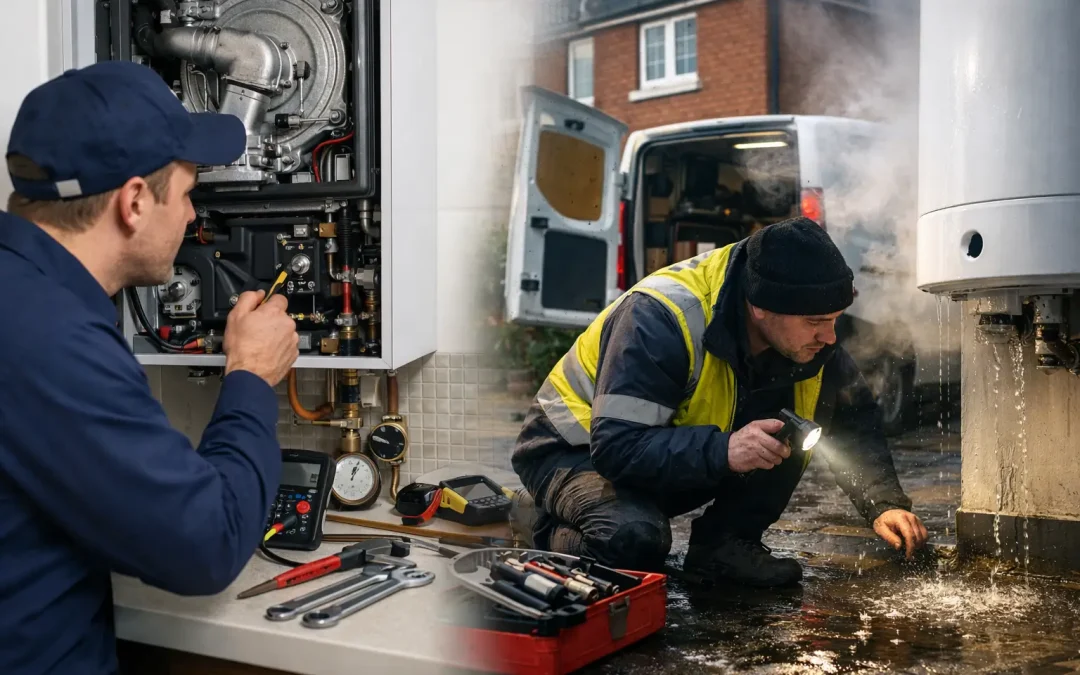
A boiler often causes disruption at the least convenient time: during a winter tenancy, before a property viewing, or when a household has no heating or hot water. The choice between an annual boiler service vs breakdown callout is therefore not simply about timing. It affects safety, tenant communication, repair planning and how much pressure is placed on the person responsible for the property.
For homeowners, a breakdown can mean an uncomfortable and unexpected repair. For landlords, letting agents and property managers, it can also mean arranging access, keeping tenants informed, assessing whether further works are needed and recording the outcome properly. A planned service will not prevent every fault, but it gives problems far less opportunity to become urgent.
What an annual boiler service is designed to do
An annual boiler service is a planned inspection and maintenance visit carried out by a suitably qualified Gas Safe registered engineer. The precise checks depend on the boiler make, model and condition, but the purpose is consistent: to confirm that the appliance is operating safely and identify signs of wear, poor performance or developing faults.
A service may include checking the boiler’s controls and pressure, inspecting key components, testing safe operation, reviewing the flue and ventilation arrangements, and cleaning parts where appropriate. The engineer can also identify whether a component is approaching the end of its useful life or whether the system would benefit from further attention.
The value is not that a boiler becomes fault-proof for another 12 months. Boilers contain mechanical and electrical parts that can fail without warning. Instead, servicing creates a regular opportunity to spot concerns while there is still time to plan a repair around the occupant, rather than reacting when the heating stops working.
For rental properties, annual servicing also supports a more organised compliance process. Landlords have specific legal duties around gas safety, including obtaining a valid Gas Safety Record at the required intervals. A boiler service and a landlord gas safety check are not automatically the same thing, even if they are arranged at the same visit. It is sensible to confirm exactly what work and documentation are included.
What happens during a breakdown callout?
A breakdown callout is reactive. The boiler has stopped working, is showing a fault code, is losing pressure repeatedly, making unusual noises or failing to provide reliable heating or hot water. The immediate aim is to diagnose the problem, make the appliance safe and, where possible, restore operation.
Sometimes the repair is straightforward. It may involve an adjustment, a failed sensor, a pressure issue or a replaceable part that is available promptly. In other cases, diagnosis identifies a wider issue such as a leak, a failing pump, a fault in the heating controls or a system condition that needs additional work.
This is where the practical difference becomes clear. A breakdown visit often begins with uncertainty. The cause is not known, replacement parts may be needed, and access may have to be arranged around tenants or working households. If the boiler cannot be repaired on the first visit, the property may need temporary arrangements while the next steps are organised.
A callout is essential when a problem occurs, but it is rarely the most controlled way to manage a boiler. It is the right response to a fault, not a replacement for routine maintenance.
Annual boiler service vs breakdown callout: the real trade-off
The main trade-off is between planned attention and unplanned disruption. An annual service creates a scheduled appointment at a time that works for the household or tenant. A breakdown callout responds to an issue after comfort, convenience or compliance may already have been affected.
Planned servicing can help to reduce the likelihood of avoidable failures and can reveal issues before they cause a complete loss of heating. It may also help to maintain manufacturer warranty requirements, where these apply. However, it does not remove the possibility of a sudden fault. Electrical components, controls and parts subject to wear can fail between services.
A breakdown callout may feel more economical when a boiler appears to be working well. But that view can change quickly if the fault occurs in cold weather, requires several visits, or causes a tenant complaint and urgent property management work. The cost is not limited to the repair itself. There is also the time spent taking reports, arranging access, communicating updates and handling the effect on the household.
For an owner-occupier, the decision may come down to risk tolerance and the age of the appliance. For a landlord or agent managing several properties, planned servicing is usually part of a wider maintenance approach that protects tenants and reduces last-minute administration.
Signs a boiler should not wait for its next service
A boiler that is still running is not necessarily operating as it should. Repeated pressure loss, inconsistent hot water, cold radiators, unusual banging or whistling noises, visible leaks, persistent fault codes and rising energy use can all justify earlier investigation.
Do not ignore a suspected gas issue. If there is a smell of gas, a carbon monoxide alarm activates, or occupants feel unwell and suspect fumes, follow the relevant gas emergency guidance immediately and do not attempt to investigate or repair the appliance yourself.
Less urgent symptoms should still be logged and reported promptly, especially in rented homes. A small leak beneath a boiler, for example, can develop into damage to cupboards, ceilings or flooring. What begins as a heating repair can become a multi-trade property maintenance issue involving plumbing repairs, plastering, decorating or replacement materials.
A better approach for landlords and letting agents
Good boiler management depends as much on administration as it does on the appliance. The most effective process begins before the annual date is due. Keep a clear record of the service date, Gas Safety Record, engineer findings, boiler model, warranty position and any previous repairs. This makes it easier to book work early and gives the attending engineer useful context if a fault later develops.
Tenant communication matters too. Give reasonable notice, explain the purpose of the visit and make it easy for the occupant to confirm access or raise concerns about how the heating has been performing. Tenants are more likely to report early warning signs when they know what to look for and who to contact.
Where a repair involves more than the boiler itself, coordination becomes particularly valuable. A leak might affect joinery or decoration. A radiator issue may require a plumbing repair followed by making good. Southdown Group can help landlords, agents and property managers organise the wider property work around a repair, including access arrangements, scheduling, photographic updates and completion communication.
When a boiler repair becomes a wider property decision
Older boilers can reach a point where repeated repairs are no longer the most sensible route. That does not mean every fault requires replacement. A dependable appliance with an isolated, repairable issue may continue to provide good service. The decision depends on the nature of the fault, the appliance’s age and history, the availability of parts, energy performance and the condition of the wider heating system.
For landlords preparing a void property, this is a useful time to assess heating alongside other maintenance items. Decorating, radiator upgrades, leak repairs, ventilation improvements and general refurbishment can often be planned in a logical order, reducing repeat visits and avoiding damage to completed work.
The same applies to homeowners undertaking a kitchen improvement or renovation. If pipework, radiators or boiler controls need attention, it is usually better to consider them before surfaces are redecorated or joinery is finished. A coordinated plan prevents one necessary repair from undoing another completed job.
Plan the service, prepare for the fault
The sensible answer is not to choose one approach and ignore the other. Arrange annual servicing and gas safety work at the correct interval, keep records organised, and have a clear reporting process if something fails between visits. A breakdown cannot always be avoided, but its impact can be managed far more effectively when the property, paperwork and communication are already in order.
A well-maintained boiler is not just a matter of warmth. It helps homeowners protect their home, gives tenants greater reassurance and allows property managers to deal with the unexpected as a controlled repair rather than a preventable crisis.