
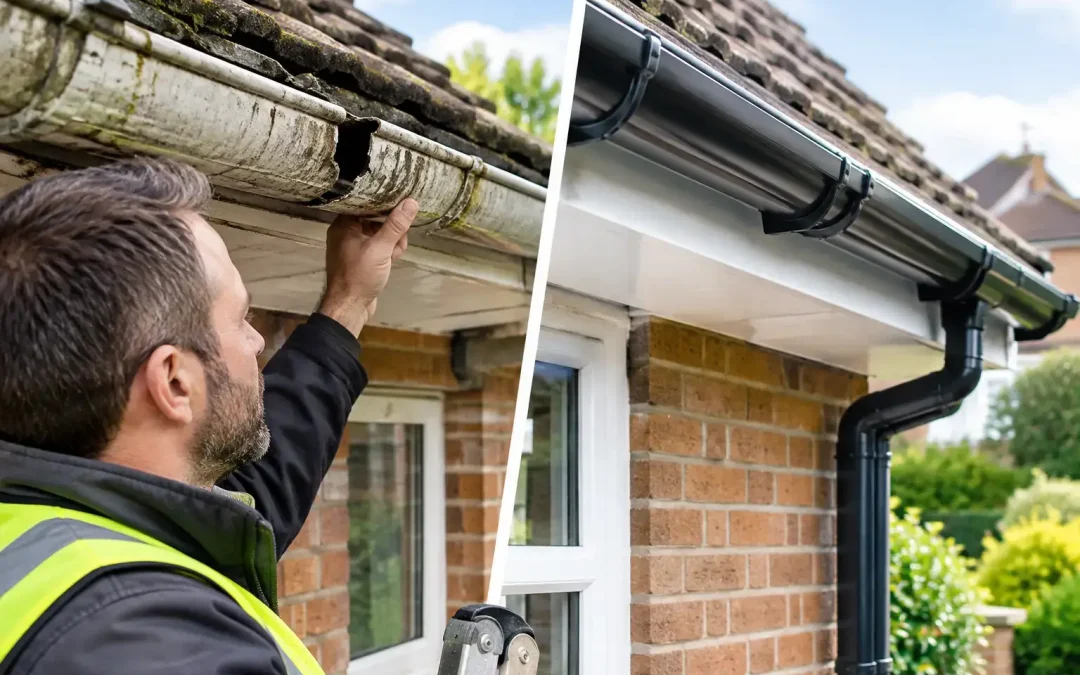
A small drip from a gutter can look like a minor maintenance job until the brickwork beneath it starts staining, water tracks into a soffit, or damp appears inside a rental property. The decision around repair versus replace guttering is therefore less about making the quickest visible fix and more about preventing repeat damage to the building.
For homeowners, landlords and property managers, the right answer depends on the condition of the whole gutter run, not just the point where water is escaping. A properly assessed repair can extend the life of sound guttering. Where the system has reached the end of its useful life, replacement is often the more controlled and cost-effective route.
When gutter repairs are the sensible option
Guttering can often be repaired where the issue is isolated and the surrounding sections remain secure, correctly aligned and in good condition. A leaking union, worn seal, loose bracket or blocked outlet does not automatically mean the entire system needs replacing.
Repairs are usually appropriate when a section has been knocked out of position, a joint has opened, or one length has cracked through impact or age while the rest of the run is still sound. Re-securing brackets, replacing a damaged length, renewing seals and correcting the fall of the gutter can restore reliable drainage without unnecessary work.
The fall is particularly important. Guttering should direct rainwater steadily towards the outlet without standing water along its length. If water sits in one place, overflows during heavy rain or repeatedly escapes from a joint, the cause may be poor alignment rather than a failed gutter itself. Correcting that detail can make a repair last.
For a property with relatively modern uPVC guttering, an isolated repair is commonly the practical choice. It protects the exterior while avoiding disruption to parts of the system that still have plenty of serviceable life left.
Signs that replacement is likely to be better
Replacement becomes more sensible when defects are widespread or when several repairs have already been carried out. Guttering is a connected system: a new joint or bracket will not resolve recurring problems caused by brittle pipework, distorted lengths, inadequate support or poor previous installation.
Look beyond the visible leak. These signs usually justify a closer assessment of full or partial replacement:
- Repeated leaks at multiple joints or along several runs
- Sagging lengths, frequent standing water or gutters pulling away from the fascia
- Brittle, faded or cracked uPVC that breaks when handled
- Rust, corrosion or holes in older metal guttering
- Downpipes that regularly block, overflow or discharge too close to the property
- Rotten fascias, damaged soffits or deteriorated fixings behind the guttering
Where a number of these issues are present, continued patch repairs can become false economy. Each visit may resolve one immediate fault, but the property remains exposed to further leaks and the administration of repeated maintenance.
This is especially relevant for landlords and letting agents managing occupied homes. Water ingress can lead to tenant concerns, damaged decorating, damp reports and avoidable follow-up visits. Replacing a failing system in a planned visit can be less disruptive than responding to the next failure after heavy rainfall.
Repair versus replace guttering: assess the cause, not only the leak
The most useful question is not, “Can this leak be repaired?” In many cases, it can. The more important question is, “Why has it leaked, and is the rest of the system likely to do the same?”
A gutter joint may leak because its seal has worn out. That is a straightforward repair if the guttering remains firm and properly supported. But if the joint is opening because long sections are sagging between brackets, simply changing the seal does not deal with the underlying issue.
Similarly, overflow may be caused by leaves and moss, but a clear gutter that still overflows may have insufficient fall, undersized outlets or a downpipe obstruction. A property maintenance contractor should assess the gutter run, outlets, brackets, downpipes, fascia condition and the ground-level drainage route before recommending work.
This approach matters where water has already affected other parts of the property. Stained brickwork, peeling paint, decayed timber, damaged render and internal damp can all be symptoms of rainwater failing to move away from the building. Guttering work may need to be coordinated with roofing repairs, fascia repairs, exterior decorating, brickwork repairs or internal making-good work.
Consider the age and material of the existing system
The age of the guttering is a useful guide, although condition matters more than a fixed number of years. Older uPVC can become brittle after prolonged exposure to sunlight and temperature changes. It may look acceptable from ground level but split around joints and screw points when disturbed.
Metal systems may be durable, but corrosion, failed coatings and poorly maintained joints can create persistent leaks. Cast iron, for example, can often be retained and repaired where it remains structurally sound, but extensive corrosion or poor previous repairs may make replacement the more dependable option.
Matching also matters. Adding a new section to old guttering can work, but differences in profile, colour, age and movement can make joints harder to maintain. If only a short length is damaged, a matching repair is usually sensible. If several sections are nearing failure, replacing a full elevation may produce a cleaner and more reliable result.
Do not overlook fascias, soffits and roof edges
Guttering cannot perform properly if the structure supporting it is compromised. Loose brackets may be a guttering issue, but they can also indicate soft or rotten timber fascias. Fixing new brackets into damaged timber may only postpone the problem.
Water overflowing behind a gutter can damage the fascia board and soffit, while a roof edge that does not discharge correctly can overwhelm even well-installed guttering. These details are easy to miss during a quick repair, yet they determine whether the work will last.
For this reason, replacement projects should include a check of the boards and fixings behind the guttering. If repairs are required, it is generally more efficient to coordinate them at the same time rather than remove newly fitted guttering later to access the area.
Planning work for rental and managed properties
For a homeowner, guttering work is usually a question of protecting the house and avoiding larger repair bills. For landlords, letting agents and property managers, it also requires clear tenant communication, safe access arrangements, approval of quotations and a reliable record of what was completed.
An organised maintenance process reduces avoidable delays. The contractor should be able to establish the reported issue, arrange access where needed, assess the condition on site and explain whether a targeted repair or replacement offers the better outcome. Photographs before and after work are particularly helpful where the property owner is not local or several stakeholders need an update.
Where work affects multiple trades, one point of coordination is valuable. A guttering replacement may uncover failed fascia boards, damaged render or decoration affected by water ingress. Managing this as one planned scope helps avoid separate bookings, unclear responsibility and unfinished making-good work.
Southdown Group supports property maintenance work across Loughborough and the surrounding area with an office-supported process for scheduling, communication, quotations and completion updates. That structure is useful when a simple exterior repair develops into wider maintenance work that needs to be controlled properly.
Make the decision based on value over time
A repair is the right choice when it resolves a local fault in an otherwise reliable system. Replacement is the better choice when the guttering has deteriorated across several areas, when supporting elements are failing, or when ongoing repairs are becoming a pattern.
Neither option should be chosen on appearance alone. Rainwater problems can be gradual, and the damage often becomes visible only after moisture has affected timber, masonry or internal finishes. A clear assessment of the cause, condition and likely lifespan of the existing guttering gives property owners a sound basis for action.
The aim is simple: keep rainwater moving away from the building, deal with defects before they affect other elements, and choose work that will remain dependable through the seasons ahead.